
Flexible Dies in Self-Adhesive Label Production
INTRODUCTION TO DIE-CUTTING
What is Die-Cutting?
Die-cutting is the process of converting a printed self-adhesive label web into individual labels by cutting the face material and adhesive layer while leaving the release liner intact.
The main objectives are:
Ensure reliable waste matrix removal.
Produce the required label shape.
Maintain accurate dimensions.
Achieve clean and consistent edges.
Avoid cutting through the release liner.
Basic Process
Printed Label Web → Die-Cutting → Matrix Removal → Individual Labels on Liner → Rewinding
SELF-ADHESIVE LABEL CONSTRUCTION
A typical pressure-sensitive label consists of three main layers:
- Face Stock
The printable material.
Examples:
- Paper
- PP
- PE
- PET
- Specialty films
- Pressure-Sensitive Adhesive
Provides adhesion between the label and the final product.
- Release Liner
Protects the adhesive and supports the label during printing and application.
Critical Die-Cutting Requirement
The die must cut:
Face Stock + Adhesive
But must not completely cut through the release liner.
WHAT IS A FLEXIBLE DIE?
Flexible Die Definition
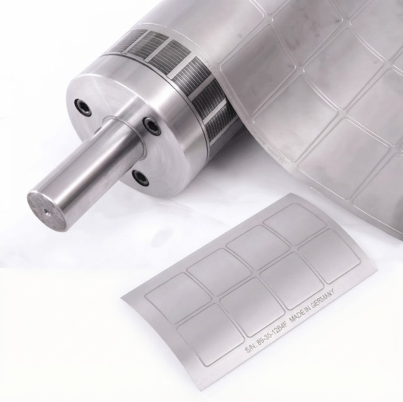
A flexible die is a thin, precision-manufactured steel cutting plate containing a specific cutting pattern. It is mounted onto a magnetic cylinder and rotates against an anvil cylinder to cut the label material.
Key Characteristics
- Thin steel construction
- Flexible enough to wrap around a magnetic cylinder
- Precision-etched or manufactured cutting pattern
- Easily replaceable
- Designed for rotary die-cutting
- Suitable for high-speed label production
FLEXIBLE DIE SYSTEM
Main Components
A flexible die-cutting station normally consists of:
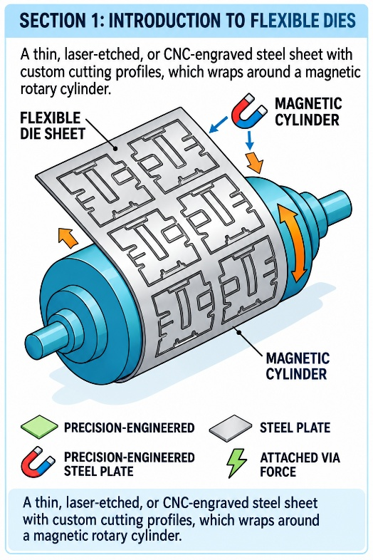
- Flexible Die
- Magnetic Cylinder
- Anvil Cylinder
- Die-Cut Web
- Pressure Adjustment System
- Matrix Removal System
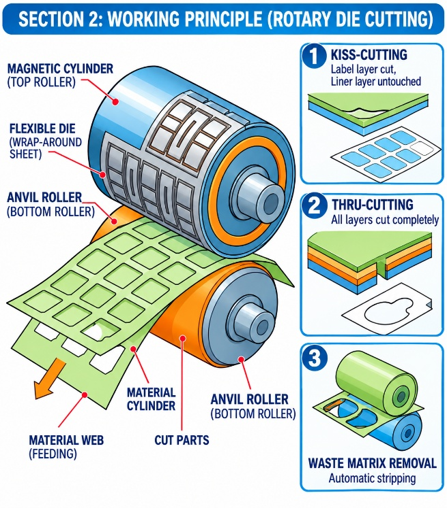
Working Principle
The flexible die is magnetically attached to the cylinder.
As the cylinder rotates:
Flexible Die → Cuts Material → Against Anvil → Matrix Removed
FLEXIBLE DIE CONSTRUCTION
Main Elements of a Flexible Die
Steel Base
The thin steel base allows the die to bend around the magnetic
cylinder.
Cutting Rule
The raised cutting edge performs the actual cutting operation.
Cutting Pattern
The pattern determines:
- Label shape
- Label dimensions
- Corner radius
- Waste matrix configuration
- Perforations
- Special features
Back Surface
The magnetic cylinder holds the flexible die firmly against its surface.
FLEXIBLE DIE & MAGNETIC CYLINDER
The Magnetic Cylinder
The magnetic cylinder is the foundation of the flexible die system.It contains a powerful magnetic surface that holds the flexible die accurately in position.
Important Features
- Precision-ground surface
- High concentricity
- Strong magnetic holding force
- Accurate repeat circumference
- Easy die mounting and removal
Advantages
✔ Quick job changeover
✔ Excellent repeatability
✔ Reduced setup time
✔ No mechanical clamping required in many systems
HOW FLEXIBLE DIE-CUTTING PROCESS
Rotary Die-Cutting Process
Step 1 – Web Enters the Die Station
The printed self-adhesive material enters between the: Flexible die cylinder Anvil cylinder
Step 2 – Cutting Contact
The cutting edge contacts the material under controlled pressure.
Step 3 – Material Is Cut
The die cuts through: Face material Adhesive
Step 4 – Release Liner Remains Intact
The liner should receive only a controlled impression or partial penetration.
Step 5 – Matrix Removal
The unwanted material surrounding the labels is removed.
THE IMPORTANCE OF DIE-CUTTING DEPTH
Correct Cutting Depth Is Critical
The cutting depth must be precisely controlled.
Too Shallow
The face material may not be completely cut.
Problems:
- Labels do not separate properly
- Matrix removal difficulties
- Incomplete label edges
Too Deep
The die damages or cuts through the liner.
Problems:
- Liner breaks
- Web breaks during converting
- Label dispensing problems
- Automatic application failures
Ideal Condition
Face Stock + Adhesive = Completely Cut
Release Liner = Remains Intact
KISS CUTTING
What is Kiss Cutting?
Kiss cutting is the most common die-cutting method for pressure-sensitive labels.
The die cuts:
- Face Stock
- Adhesive
But does not cut completely through:
✘ Release Liner
The term “kiss cut” refers to the controlled contact between the die and liner.
Main Purpose
To create individual labels while maintaining the continuous liner web for:
- Rewinding
- Dispensing
- Automatic label application
FULL CUT AND PERFORATION
Different Cutting Operations
- Kiss Cut
Cuts the label material but leaves the liner intact.
Used for: Pressure-sensitive labels.
- Full Cut
Cuts completely through all layers.
Used for:
- Sheets
- Tickets
- Tags
- Individual products
- Perforation
Creates a series of controlled cuts and ties.
Used for:
- Easy separation
- Multi-part labels
- Tickets
- Promotional labels
FLEXIBLE DIE SPECIFICATIONS
When ordering a flexible die, several technical specifications are required.
Cylinder Repeat
- The circumference or repeat length of the magnetic cylinder.
- Number of Labels Around
Number of label repeats around the cylinder circumference.
- Number of Labels Across
Number of label lanes across the web.
- Label Dimensions
- Width
- Length
- Corner radius
Web Direction
The orientation of the label in the machine direction.
Material Type
Paper
Film
Thickness
Adhesive type
UNDERSTANDING REPEAT LENGTH
Repeat Length
The repeat length is the distance required for one complete pattern repeat around the die-cutting cylinder.
Formula : Cylinder Repeat = π × Cylinder Diameter
Where: π = 3.1416
Diameter = effective cylinder diameter
Importance
The flexible die must match the exact repeat of the magnetic cylinder.
If the repeat is incorrect:
❌ The die will not fit correctly.
❌ Registration problems may occur.
❌ The cutting pattern will not synchronize with printing.
LABEL LAYOUT AND DIE DESIGN
Factors Affecting Die Layout
The die manufacturer must consider:
Label Size : Width × Length.
Gap Between Labels
The spacing between adjacent labels.
Web Width
Available printable and converting width.
Matrix Structure
The waste material must be removable without breaking.
Number Across
Number of labels positioned across the web.
Repeat Direction
Number of labels around the cylinder.
GAP BETWEEN LABELS
Why Is the Label Gap Important?
The gap between labels provides space for the waste matrix.
If the Gap Is Too Small:
- Matrix may break
- Waste removal becomes difficult
- Die accuracy requirements increase
If the Gap Is Too Large:
- Material waste increases
- Lower production efficiency
Typical Considerations
The correct gap depends on:
- Label material
- Label size
- Press speed
- Matrix strength
- Label shape
- Adhesive properties
MATRIX REMOVAL
What Is the Matrix?
The matrix is the unwanted material surrounding the die-cut labels. After die-cutting, it is stripped away and rewound as waste.
Successful Matrix Removal Requires:
✔ Complete cutting of the face material
✔ Correct die pressure
✔ Strong enough matrix structure
✔ Suitable stripping angle
✔ Proper web tension
Poor Matrix Removal Can Cause:
- Web breaks
- Label lifting
- Missing labels
- Production downtime
DIE CLEARANCE AND PRESSURE
The Correct Die Pressure
Pressure must be sufficient to cut the face material completely but must not excessively damage the liner.
Excessive Pressure Causes:
❌ Liner cutting
❌ Premature die wear
❌ Anvil damage
❌ Web breaks
Insufficient Pressure Causes:
❌ Incomplete cutting
❌ Poor matrix stripping
❌ Labels remaining connected
Principle:
Use the minimum pressure required to achieve a complete and consistent cut.
ANVIL CYLINDER
Function of the Anvil
The anvil cylinder provides the hard supporting surface against which the flexible die cuts.
Requirements
- High surface hardness
- Excellent concentricity
- Smooth surface
- Accurate rotation
Anvil Damage Can Cause:
- Uneven cutting
- Repeating cutting defects
- Poor label separation
- Variations across the web
The anvil should be regularly inspected and maintained.
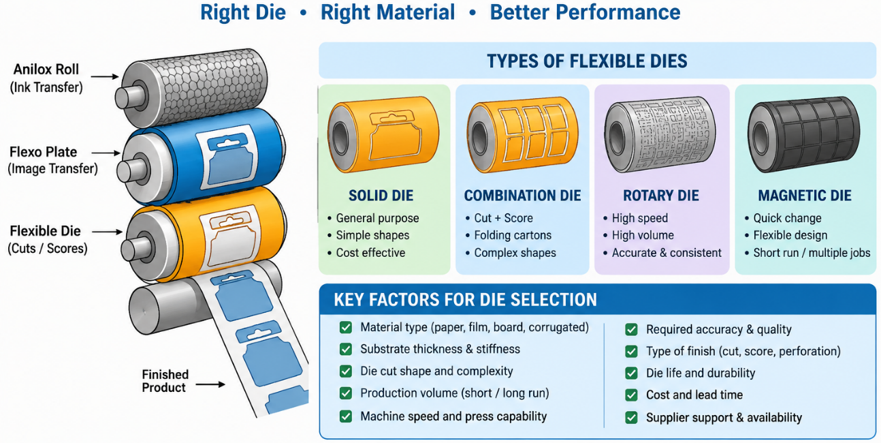
FLEXIBLE DIE SELECTION
How to Select the Correct Flexible Die
Consider the following:
Label Material
Paper and film require different cutting characteristics.
Material Thickness
Thicker constructions may require different cutting geometry.
Adhesive Type
Aggressive adhesives can increase die contamination.
Label Shape
Complex shapes require precision die design.
Press Speed
High-speed production requires excellent die and material performance.
Production Volume
Higher volumes may justify longer-life or specially treated dies.
Paper Versus Film Materials
Die-Cutting Paper Labels
Generally easier to die-cut because paper has a stable structure.
Considerations
- Paper dust
- Fiber cutting
- Adhesive contamination
FLEXIBLE DIE MAINTENANCE
Routine Maintenance
After Each Production Job
- Remove adhesive and material residue
- Inspect cutting edges
- Clean carefully
- Dry completely
Periodically
- Inspect for wear
- Check for damaged cutting areas
- Examine corrosion
- Verify dimensional condition
Benefits
✔ Longer die life
✔ Better cutting quality
✔ Reduced downtime
✔ Lower tooling cost
DIE LIFE
Factors Affecting Flexible Die Life
Die life is influenced by:
Material Being Cut
Paper, film and abrasive materials affect wear differently.
Operating Pressure
Excessive pressure dramatically reduces die life.
Production Volume
More revolutions naturally increase wear.
Cleaning Practices
Incorrect cleaning can damage the edge.
Anvil Condition
A damaged anvil can rapidly destroy the cutting edge.
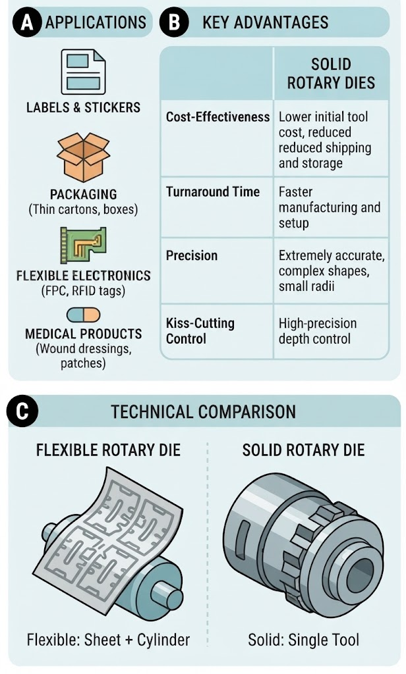
FLEXIBLE DIE ADVANTAGES
Why Use Flexible Dies?
Fast Changeover
Dies can be quickly removed and replaced.
Lower Tooling Cost
Generally more economical than some solid rotary tooling systems.
Easy Storage
Thin flexible dies require less storage space.
High Precision
Modern manufacturing provides excellent accuracy.
Suitable for Multiple Jobs
One magnetic cylinder can support different flexible die patterns with the same repeat.
LIMITATIONS OF FLEXIBLE DIES
Possible Limitations
- Requires a compatible magnetic cylinder
- Die can be damaged by improper handling
- High-pressure operation reduces life
- Very complex applications may require alternative tooling
- Different repeats require different cylinders or tooling arrangements
Key Point
Flexible dies provide excellent performance when correctly matched to:
Material + Press + Cylinder + Production Requirements
FLEXIBLE DIE VS SOLID ROTARY DIE
| Feature | Flexible Die | Solid Rotary Die |
| Tooling cost | Lower | Higher |
| Changeover | Fast | More involved |
| Storage | Easy | Requires more space |
| Magnetic cylinder | Required | Not required |
| Die replacement | Simple | Complete cylinder/tool change |
| Precision | Very high | Very high |
| Production application | Highly versatile | Often used for demanding/high-volume applications |
Best Practices
Flexible Die-Cutting Best Practices
✔ Use the correct die specification
✔ Keep the magnetic cylinder clean
✔ Use minimum effective cutting pressure
✔ Maintain stable web tension
✔ Regularly inspect the anvil
✔ Clean dies after production
✔ Protect cutting edges during storage
✔ Monitor matrix removal continuously
✔ Maintain accurate print-to-die registration
Key Takeaways
A flexible die is a precision rotary cutting tool used extensively in self-adhesive label production.
Successful flexible die-cutting depends on:
The Correct Combination of:
Flexible Die
⬇
Magnetic Cylinder
⬇
Anvil Cylinder
⬇
Correct Cutting Pressure
⬇
Stable Web Tension
⬇
Proper Matrix Removal
Final Objective
Produce clean, accurately shaped labels while completely protecting the release liner.
Final Technical Message
The Golden Rule of Flexible Die-Cutting
“Cut the Face Stock Completely — Cut the Liner as Little as Possible.”
Proper die selection, accurate setup, controlled pressure, and preventive maintenance are the foundation of high-quality, efficient, and consistent self-adhesive label production.