
Overview of Flexographic Press Fingerprinting
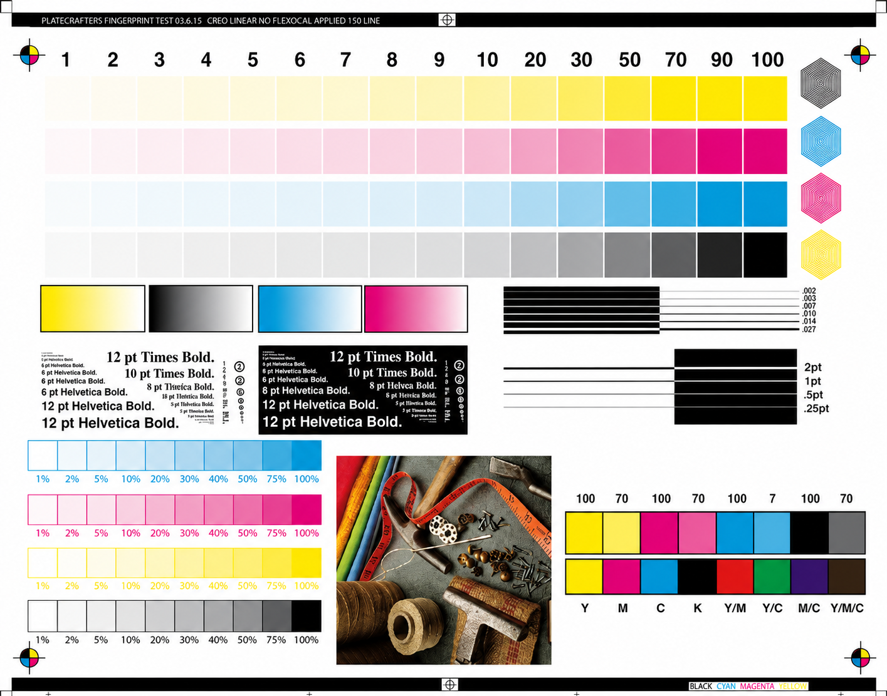
Flexographic printers continually strive to improve print quality, reduce setup times, minimize waste, and achieve greater consistency. One of the most effective methods for accomplishing these objectives is press fingerprinting.
Press fingerprinting is a systematic process used to evaluate and document the performance characteristics of a printing press under controlled operating conditions. The data gathered during this process enables printers to establish standard operating procedures and achieve predictable, repeatable results.
Why is press fingerprinting important?
The primary purpose of fingerprinting is to determine the capabilities and limitations of the printing press by measuring factors such as:
- Text and line reproduction quality
- Dot gain (tone value increase)
- Ink density and color consistency
- Registration accuracy
- Print contrast and tonal range
Once the fingerprinting process is completed, the collected data is used to create a Dot Gain Compensation (DGC) curve. This curve ensures that the printed output closely matches industry standards and customer expectations.
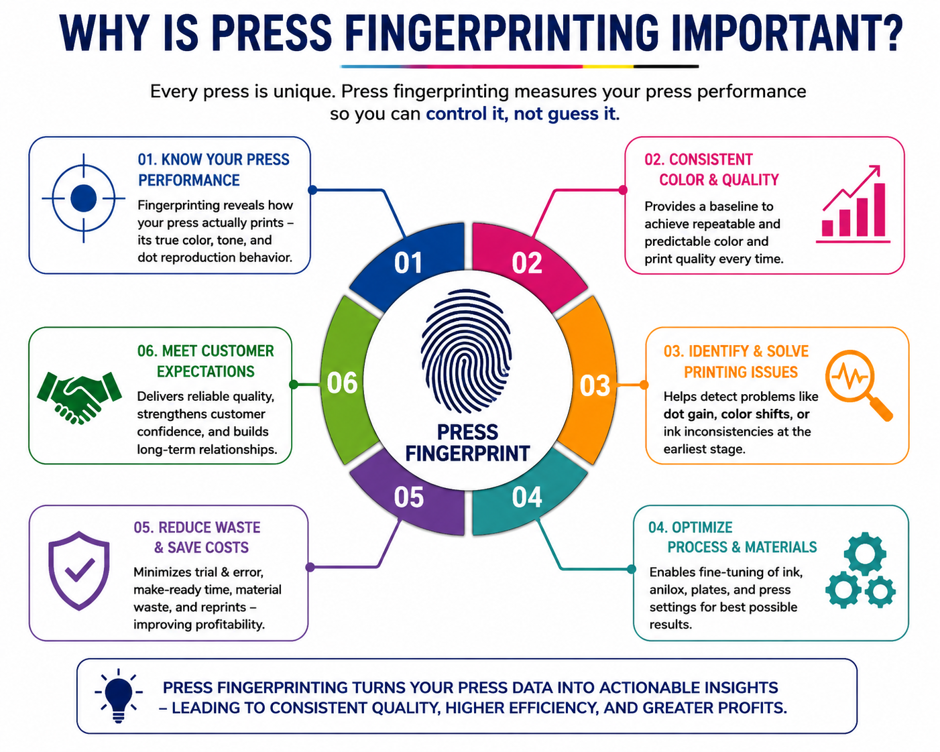
What are the main benefits of press fingerprinting?
Press fingerprinting offers several important advantages:
- Improved print quality and color consistency
- Reduced setup and make-ready times
- Lower material waste and fewer press adjustments
- Better communication between prepress and pressroom operations
- Increased efficiency and repeatability across multiple production runs
Greater confidence in achieving customer specifications
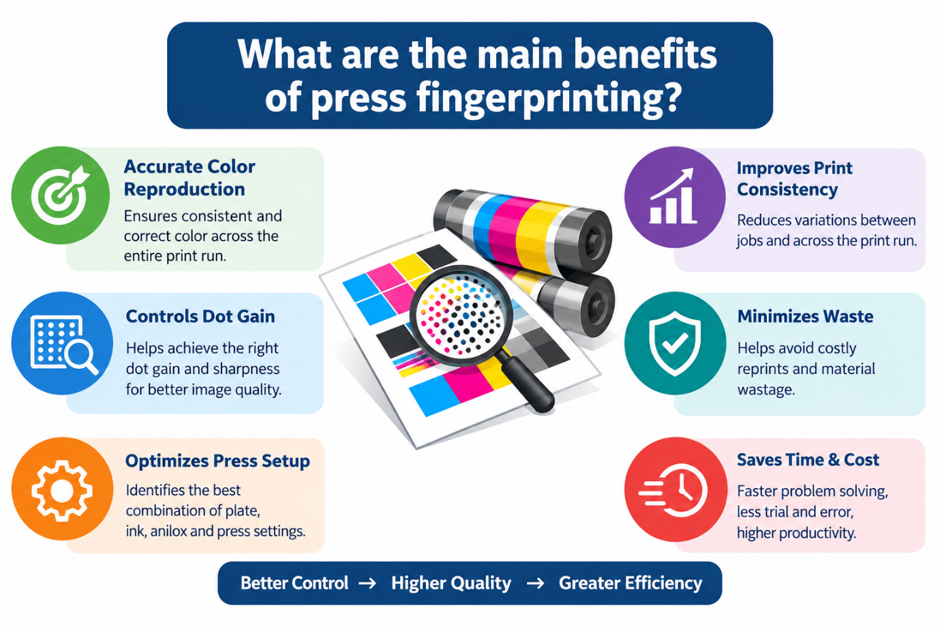
How does fingerprinting improve productivity?
Fingerprinting validates that the settings used during prepress and production will produce the desired outcome. Without this process, operators often spend additional time making adjustments on the press to correct unexpected variations.
Although the exact productivity gains may differ from one operation to another, the benefits typically include:
- Faster job setup
- Reduced downtime
- Lower substrate and ink consumption
- Fewer rejected products
- Increased overall equipment effectiveness (OEE)
In short, press fingerprinting transforms printing from a process based largely on operator experience into one driven by measurable data, resulting in higher quality, greater efficiency, and improved profitability.
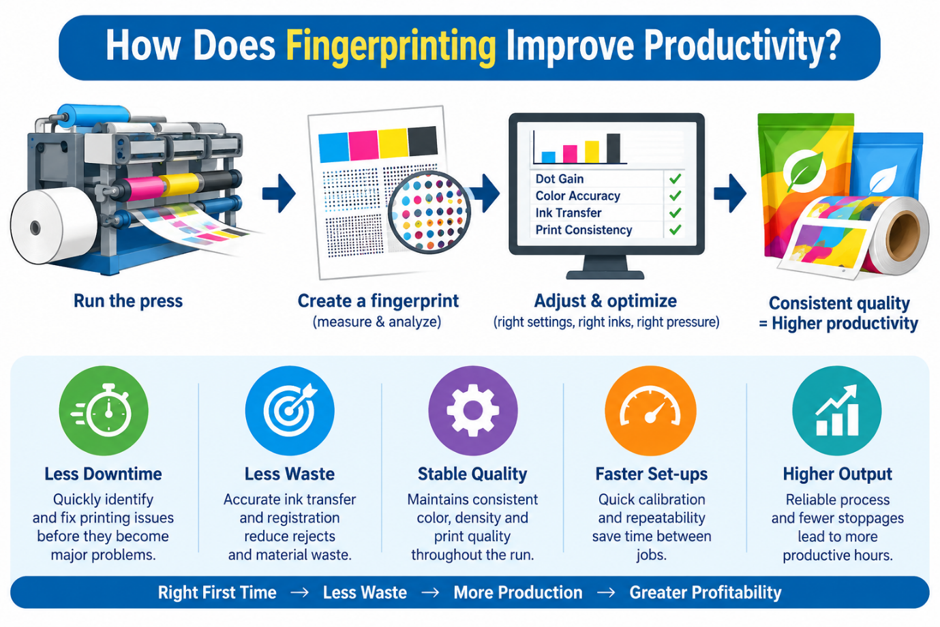
Tangible Results of the Fingerprinting Process
The fingerprinting process provides measurable data that can be used to maintain consistent print quality during everyday production. The most important outcomes include:
Verification that target density values can be achieved using the actual substrate, press speed, inks, plates, anilox rollers, and other production conditions.
Establishment of a press characterization profile that accurately represents the press’s capabilities.
Creation of a dot gain compensation (DGC) curve, which compensates for tonal value increase during printing.
Determination of optimum operating parameters, including impression settings, ink density, drying conditions, and anilox specifications.
Development of a standardized reference that operators can use to maintain repeatable print quality and reduce setup times and waste.
How Often Should Fingerprinting Be Performed?
Fingerprinting is not a one-time activity. Production jobs should include density targets, registration marks, and tint patches so operators can continuously monitor print consistency.
If the measured values remain stable but the printed results no longer match the desired appearance, the press curve may need to be modified. In such cases, a new fingerprinting process should be performed.
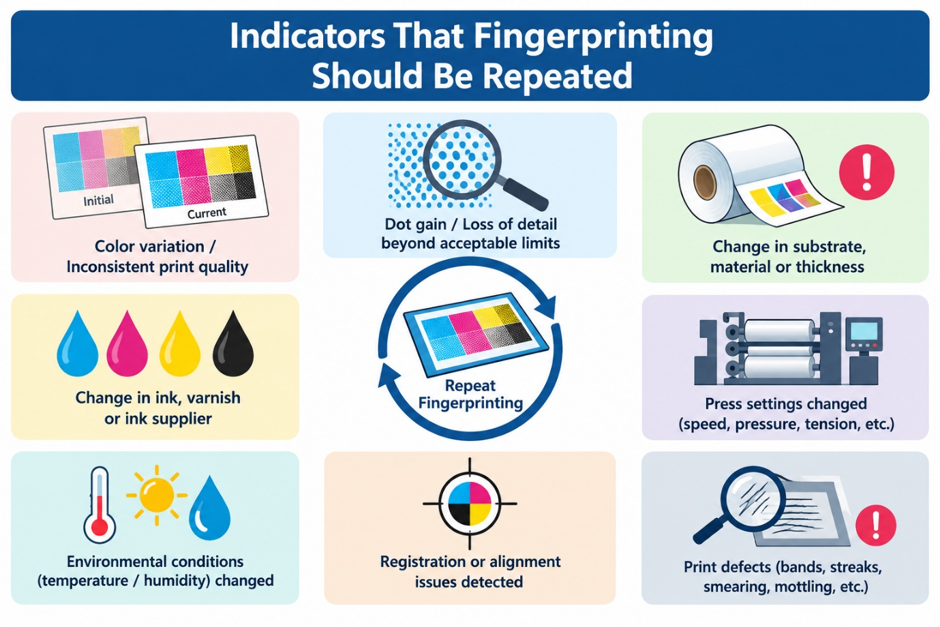
Indicators That Fingerprinting Should Be Repeated
A new fingerprint is recommended whenever significant changes occur in the printing process, including:
- A change in substrate material
- A different varnish or lamination structure
- Changes in ink chemistry or supplier
- Installation of new anilox rollers
- Changes in plate material or plate technology
- Different mounting tapes
- Modifications to press settings, drying systems, or curing conditions
In simple terms, fingerprinting should be repeated whenever any variable changes significantly enough to affect ink transfer, dot reproduction, color consistency, or overall print quality. Regular fingerprinting ensures reliable color reproduction, shorter make-ready times, reduced waste, and more predictable production performance.
Can fingerprinting a press be used to restore it to peak operating condition?
No. Press fingerprinting should not be considered a maintenance or repair procedure. Its purpose is to measure and document the performance capability of a press under a defined set of operating conditions.
Fingerprinting provides a “snapshot” of the press’s current condition and helps operators understand how the press behaves with specific combinations of:
- Press speed
- Substrate type
- Ink system
- Anilox specifications
- Printing plates
- Mounting tape
- Drying and curing conditions
To keep the press operating at its optimum level, a comprehensive preventive maintenance program should be followed. Fingerprinting simply confirms whether the press is capable of meeting the desired standards and identifies areas that may require adjustment or maintenance.
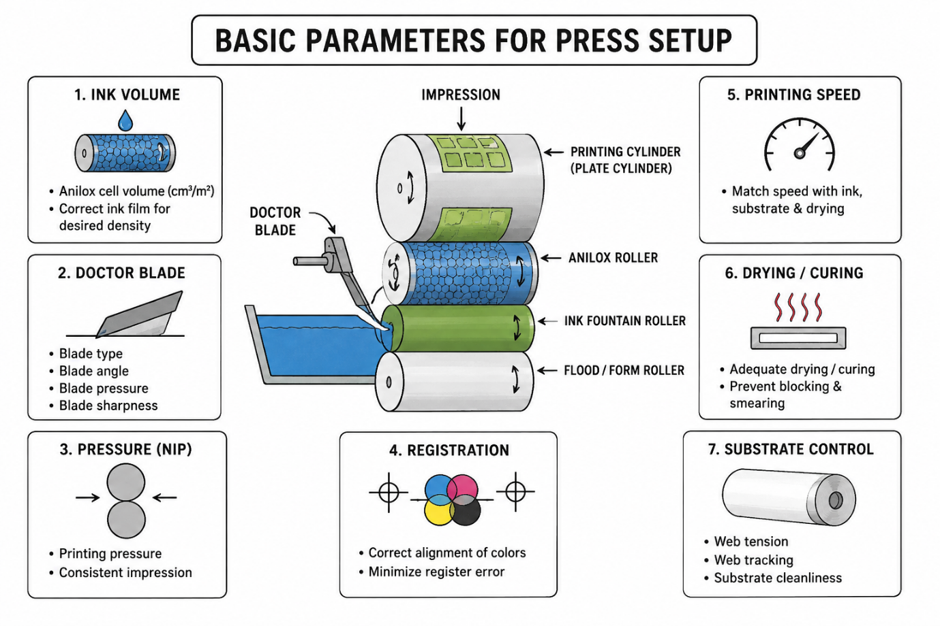
Basic parameters for press setup
Before fingerprinting begins, several variables should be carefully controlled:
- Ink viscosity and pH should remain within the manufacturer’s recommended range.
- The substrate should have the appropriate surface energy (surface tension) for proper ink transfer and adhesion.
- Cylinders and sleeves should be inspected for total indicated runout (TIR) and dimensional consistency.
- Printing pressure settings should be standardized.
- Drying and curing systems should be operating correctly.
Special Considerations for Inks Used in the Fingerprinting Process
The ink selected for a fingerprinting trial should closely match the ink that will be used during normal production. Since the objective of fingerprinting is to establish realistic and repeatable operating conditions, the following factors are critical:
- Use inks with the correct pigment strength and formulation.
- Maintain the recommended pH level and viscosity throughout the test.
- Ensure that ink temperature remains stable, as temperature fluctuations can affect viscosity and color density.
- Verify that the ink is fully mixed and free from contamination.
- Use the same drying or curing conditions that will be employed during production.
- Whenever possible, involve both the plate supplier and the ink supplier during the fingerprinting process so that technical expertise is available if adjustments are required.
Common Mistakes to Avoid
Several common errors can reduce the value and accuracy of the fingerprinting process:
- Running the press at a speed lower than normal production speed.
- Making excessive adjustments that cannot be reproduced by a typical press operator.
- Using worn or improperly cleaned anilox rolls.
- Changing multiple variables simultaneously.
- Failing to maintain consistent impression settings.
- Ignoring environmental conditions such as temperature and humidity.
- Inadequate documentation of test conditions.
The following information should always be recorded:
Anilox specifications (line screen, cell geometry, and volume)
- Plate material, thickness, and screening technology
- Mounting tape characteristics
- Ink properties, including pH, viscosity, and density
- Press speed and drying conditions
- Substrate type and specifications
In addition, all key personnel should participate in the process, including the press operator, ink supplier, plate manufacturer, tape supplier, and quality control personnel.
Fingerprinting Different Substrates
Fingerprinting should be performed separately for each substrate category because every material behaves differently during printing.
Examples include:
- Paper
- Films (PET, BOPP, PE, and others)
- Self-adhesive labels
- Corrugated board
- Paperboard and folding cartons
Each substrate possesses unique characteristics, including:
- Surface energy
- Ink absorption rate
- Smoothness and porosity
- Dimensional stability
- Drying and curing behavior
For example, a fingerprint created on a polypropylene film cannot be expected to deliver the same results on corrugated board because dot gain, ink transfer, density, and trapping characteristics will be different.
For this reason, many printers develop separate fingerprinting standards for each substrate family to ensure consistent print quality, reduced waste, shorter make-ready times, and improved overall press efficiency.
Recommended Sequence for Flexographic Press Fingerprinting
A successful press fingerprinting project should follow a structured process so that all variables are controlled and the results can be repeated consistently in production.
- Perform a banded anilox roll test
Carry out this test several weeks before the actual fingerprinting process. The objective is to determine the optimum anilox specifications for each color station.
- Order and verify materials
Ensure that all required substrates, inks, plates, tapes, solvents, and cleaning materials are available and meet the specified standards.
- Verify plate room quality control procedures
Check all plate-making parameters, including:
- Plate exposure
- Plate processing
- Plate thickness
- Relief depth
- Surface screening
- Dot reproduction
Once all specifications have been confirmed, manufacture the plates.
- Hold a project planning meeting
Gather all team members, including press operators, ink suppliers, plate manufacturers, and quality personnel, to define:
- Project objectives
- Expected results
- Responsibilities
- Measurement methods
- Acceptance criteria
- Mount the plates and prepare the press
Install the plates, mounting tapes, anilox rollers, doctor blades, inks, and substrates. Perform all standard quality-control inspections before production begins.
- Run the press at production speed
The press should always operate at normal production speed because results obtained at reduced speeds are generally unreliable.
During this stage, monitor and record:
- Ink density
- Ink film thickness
- Dot reproduction
- Minimum printable dot
- Color measurements (L*, a*, and b* values)
- Registration accuracy
Mark and retain samples produced under stable operating conditions.
- Record every process variable
Document all parameters, including:
- Press speed
- Anilox specifications
- Ink viscosity
- Ink pH
- Drying conditions
- Impression settings
- Doctor blade angles
- Environmental conditions
- Substrate characteristics
- Repeat testing if necessary
Continue making adjustments and repeating the process until all team members agree that the desired results have been achieved.
- Measure and calculate dot gain
Collect several samples during the final production run and calculate the average values. This information is then used to establish the press fingerprint and generate the appropriate dot gain compensation (DGC) curve.
Summary Flow
Banded anilox test → Material preparation → Plate production → Team review → Press setup → Production-speed printing → Data recording → Process optimization → Dot gain measurement → Final fingerprint report