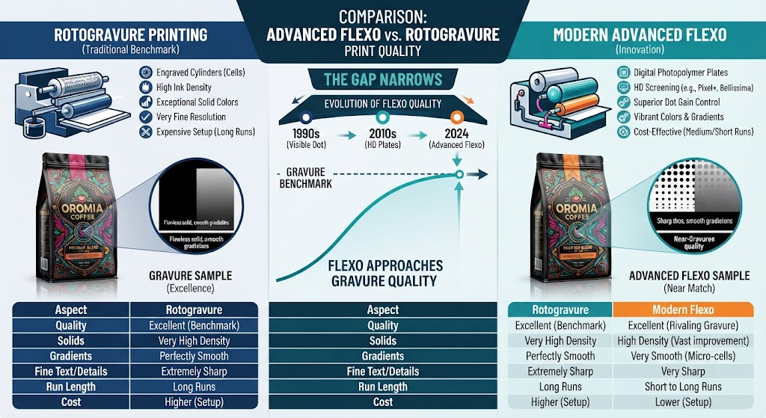
How close is modern advanced flexo printing to matching rotogravure print quality?
Modern advanced flexo has achieved near-total visual parity with rotogravure. To the naked eye, consumers and brand owners can rarely distinguish between the two on supermarket shelves.
Technological advancements—such as micro-cell surface screening (like Esko Crystal dots & Quartz Q-Cell and FLEXCEL NX), flat-top LED platemaking, and high-line anilox technology—have overcome flexo’s historical quality limitations.
Flexo vs. Rotogravure: Key Technical Benchmarks
| Performance Metric | Rotogravure Capability | Advanced Modern Flexo Capability | Quality Gap |
| Solid Ink Density (SID) | Extremely high density due to variable cell-depth ink pooling. | Match: Micro-cell patterning eliminates pinholing, matching gravure density. | Parity (0% gap) |
| Highlight Transitions | Smooth 0% fades; virtually invisible tonal breaks. | Near Match: Flat-top dots reliably hold 0.5%–1% dots for clean vignettes. | Minimal (5% gap) |
| Color Gamut & Consistency | High saturation using custom spot inks. | Match/Exceed: 7-Color Extended Color Gamut (ECG) matches 90%+ Pantone shades. | Parity (0% gap) |
| Photographic Skin Tones | Deep, natural continuous tones and subtle shadow detail. | Near Match: High-frequency screening (up to 2000 lpi) matches photographic detail. | Minimal (5% gap) |
| Heavy Metallics & Whites | Superior laydown for thick, high-opacity metallic/white inks. | Slight Edge Gravure: Gravure holds more physical ink volume for heavy metallics. | Slight gravure lead |
Where Rotogravure Still Holds an Edge
- Ultra-Long Run Wear: Steel/copper gravure cylinders can print tens of millions of meters without image degradation. Photopolymer flexo plates wear over extended runs and must be replaced.
- Heavy Pigments & Special Effects: Gravure’s deeply engraved cells transfer thicker wet-ink films, making it superior for dense opaque whites, tactile coatings, and metallic effects.
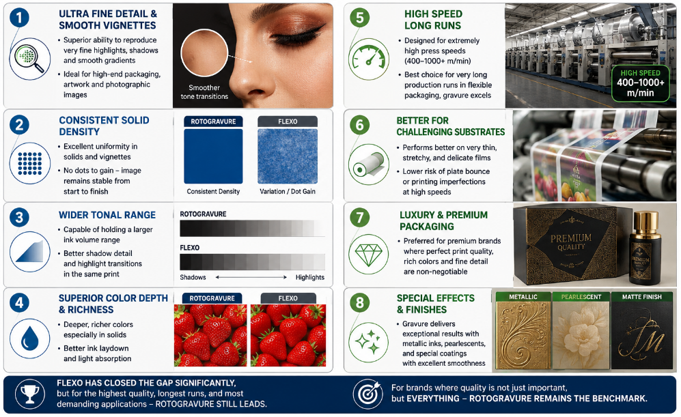
Why Brands Are Switching to Advanced Flexo
Despite gravure retaining a slight edge in metallic laydown and cylinder lifespan, flexo is rapidly capturing market share:
- Cost & Lead Time: Flexo plates cost roughly 70%–80% less than gravure cylinders and can be imaged in hours rather than days/weeks.
- SKU Proliferation: Shorter production runs and frequent packaging design updates favor flexo’s fast changeover times.
- Sustainability: Flexo works seamlessly with water-based and solvent-free inks, helping converters comply with strict environmental regulations like toluene bans.
Modern high-definition flexo printing (HD Flexo / Full HD) has closed the visual quality gap with rotogravure to roughly 90% to 95% parity. To the naked consumer eye on a retail shelf, packaging produced with advanced flexo is practically indistinguishable from rotogravure.
Performance Comparison: Advanced Flexo vs. Rotogravure
| Quality Parameter | Modern Advanced Flexo (HD / ECG) | Rotogravure (Intaglio) | Parity Level |
| Line Screen Resolution | 175–215+ LPI via high-resolution digital optics | 175–250 LPI | Near-Identical (~95%) |
| Vignettes & Highlights | Flat-top dots eliminate hard edges, fading gracefully to ~0.5% | Continuous-tone variation via cell depth | Very Close (~90%) |
| Solid Ink Density | Surface micro-patterning improves ink laydown and reduces pinholing | Deep engraved cells transfer heavier ink layers for maximum saturation | Gravure Lead (~85%) |
| Color Gamut & Accuracy | 7-color Extended Color Gamut (ECG) matches 90%+ of Pantone colors | Spot colors mixed specifically per cylinder station | Flexo Preferred for Agility |
| Run-to-Run Consistency | Plates handle 1–2 million impressions before dot wear occurs | Steel/copper cylinders print tens of millions of units without degradation | Gravure Lead at Massive Volume |
Key Technical Breakthroughs Closing the Gap
- Flat-Top Dot Imaging: Replaces traditional rounded dot profiles with flat tops, preventing oxygen inhibition and “dot bounce” on press. This allows highlights to fade seamlessly to zero without noticeable break lines.
- Surface Micro-Texturing: Laser-engraved micro-structures on photopolymer plates hold and deposit more ink, yielding smooth, opaque solids that previously required gravure’s heavy ink laydown.
- Advanced Anilox Rollers: High-LPI ceramic rollers (up to 2,000 LPI) deliver exact, repeatable ink film thicknesses to the plate surface.
- Servo-Driven Direct Drives: Automated registration systems keep tight color-to-color alignment (< 0.05 mm tolerance) even on thin flexible films.
Where Rotogravure Retains an Edge
- Maximum Solid Opacity: Gravure’s volumetric cell engraving deposits thicker ink films, making it superior for ultra-opaque whites on clear film or deep, lustrous metallic coatings.
- Extreme Volume Durability: Photopolymer flexo plates degrade under friction over long runs, while chrome-plated gravure cylinders remain visually flawless across tens of millions of meters.
- True Continuous Tone: In micro-level photographic details, gravure’s variable cell depth creates smoother tonal transitions than photopolymer relief dots.
Rotogravure still has important advantages in high-volume, premium-quality, and highly demanding packaging applications:
- Very long production runs — the engraved cylinder can deliver consistent quality over millions of impressions.
- Premium flexible packaging — excellent for high-end food, snack, confectionery, pet-food, and consumer packaging.
- Fine photographic images — capable of smooth tonal transitions, detailed highlights, and rich image reproduction.
- Large solid ink areas — produces strong, uniform solids with excellent ink laydown.
- Metallic and special-effect printing — well suited for demanding decorative finishes and high ink densities.
- Wide-web printing — effective for large-scale flexible packaging production.
- Exceptional repeatability — engraved cylinders provide highly consistent results from the first print to the last.
- Very high press speeds — particularly attractive when production volumes justify the cylinder investment.
- Long cylinder life — cylinders can be reused for repeat orders over extended periods.
- Rotogravure wins when:
- Volume is extremely high + print quality must be premium + the design will run repeatedly for a long time.
- Modern HD/advanced flexography has closed much of the quality gap, especially for shorter and medium production runs. However, for ultra-long runs, photographic quality, heavy ink coverage, and maximum consistency, rotogravure still retains an edge.
“Cost trade-offs between photopolymer flexo plates and engraved rotogravure cylinders across short, medium, and ultra-long production runs.”
- The financial trade-off between flexo and rotogravure comes down to upfront capital expenditure versus per-unit operating costs: flexo minimizes initial tooling risk, while gravure delivers unmatched unit economics at massive scale.
Financial & Operational Cost Factors
| Cost Vector | Photopolymer Flexo Plates | Engraved Gravure Cylinders |
| Initial Tooling (per color) | $150 – $500 | $1,500 – $4,000+ |
| Complete Set Prepress Cost | $1,500 – $4,000 | $12,000 – $30,000+ |
| Tooling Turnaround Time | 24 to 48 hours | 1 to 3 weeks |
| Makeready & Press Setup | Low time & material waste | High ink/substrate waste during startup |
| Tooling Lifespan | ~1M – 2M impressions | 5M – 10M+ impressions (re-chromeable) |
| Storage & Handling | Flat, lightweight, low-cost storage | Heavy, bulky copper/steel cylinder storage |
Economics Across Production Volumes
- Short Runs (< 100,000 meters / units)
- Winner: Flexo
- Impact: Amortizing a $20,000 gravure cylinder set over a 20,000-unit run adds an unsustainable $1.00 per unit in prepress costs. A flexo plate set adds roughly $0.10 per unit. Flexo’s fast press setups and minimal makeready waste preserve profit margins on short turnarounds.
- Medium Runs (100,000 to 500,000 meters / units)
- Winner: Flexo (HD / ECG)
- Impact: This is the primary competitive crossover zone. Modern HD Flexo plates complete these runs on a single set without dot wear. Gravure only competes here if the packaging artwork is strictly static and guaranteed to be re-run repeatedly over multiple years.
- Ultra-Long Runs (1,000,000+ meters / High-Frequency Re-orders)
- Winner: Rotogravure
- Impact: Flexo plates wear down under continuous friction, requiring multiple replacement plate sets over a multi-million-unit campaign. Gravure cylinders run virtually indefinitely with minimal wear, run at higher press speeds, and yield the lowest overall cost-per-pack at extreme volumes.