
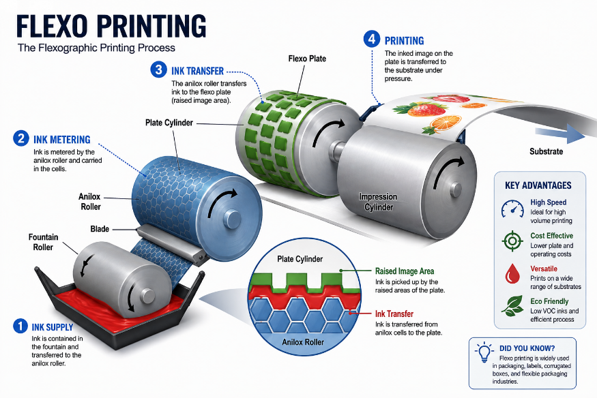
Flexographic printing (commonly called flexo printing) is a modern, high-speed printing process that uses flexible relief printing plates mounted on rotating cylinders. It evolved from traditional letterpress printing technology but offers much greater versatility, higher production speeds, and the ability to print on a wide variety of materials.
Definition
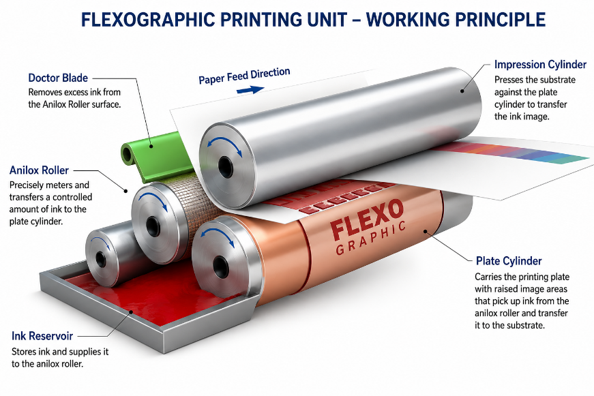
In flexographic printing, raised image areas on a flexible photopolymer plate transfer ink onto the surface of a substrate. The printing plate is attached to a plate cylinder, while an anilox roller precisely controls the amount of ink delivered to the plate.
The process is widely used because it provides:
- High printing speeds
- Excellent color consistency
- Compatibility with numerous substrates
- Fast drying and curing
- Economical long production runs
Applications of Flexographic Printing Technology
Flexography continues to be one of the fastest-growing printing technologies and is no longer limited to specialty applications. Owing to its high printing speed, excellent image quality, and ability to print on a wide variety of substrates, flexography has become one of the most widely used printing processes in the packaging and converting industry.
One of the major advantages of flexography is its ability to print on both porous and non-porous materials, including paper, paperboard, plastics, metallic films, cellophane, aluminum foil, and laminated substrates. This versatility makes it an ideal choice for numerous commercial and industrial applications.
Food packaging remains one of the largest market segments because flexographic printing offers excellent adhesion, durability, and high production efficiency on plastic films and other packaging materials. The process is equally effective for printing on plastic bags, pouches, and multilayer flexible packaging structures.
- Food packaging materials
- Plastic bags and polyethylene films
- Paper bags and shopping bags
- Paper cups and disposable food containers
- Wallpaper and decorative wall coverings
- Flexible packaging pouches and sachets
- Self-adhesive labels and tags
- Corrugated boxes and cartons
- Folding cartons
- Tissue paper products
- Gift wraps and decorative packaging
- Security labels and specialty applications
Major Industries Served
- Food and beverage industry
- Pharmaceutical industry
- Cosmetics and personal care products
- Household products
- Industrial packaging
- Agricultural products
- Consumer goods manufacturing
Because of its combination of speed, versatility, cost efficiency, and excellent print quality, flexography continues to strengthen its position as one of the most important printing technologies in the global packaging industry.
Anilox Rolls
The term “anilox” originated from the aniline-based inks that were widely used in the flexographic printing industry until the 1950s. These inks contained aniline dyes, which were later found to pose significant health risks. As a result, the industry gradually shifted to safer pigment-based inks, which remain the standard today.
Although aniline inks are no longer used, the ink-transfer roller retained the name anilox roller, and it continues to be one of the most important components of a flexographic printing press.
An anilox roller is designed to transfer a precisely controlled amount of ink from the ink chamber to the printing plate. Its surface is engraved with thousands of microscopic cells that hold and deliver a uniform volume of ink. Modern anilox rollers are generally manufactured from steel and coated with ceramic materials to provide excellent wear resistance and long service life.
Main Functions of an Anilox Roller
- Metering an exact quantity of ink.
- Ensuring consistent ink density throughout the print run.
- Improving print quality and color uniformity.
- Reducing ink waste.
- Maintaining high printing speeds.
Characteristics of Modern Flexographic Inks
Modern flexographic inks possess the following characteristics:
- Low viscosity for efficient transfer.
- Rapid drying properties.
- Excellent adhesion to various substrates.
- Compatibility with water-based, solvent-based, and UV-curable formulations.
- Suitability for high-speed printing operations.
1. Stack Press
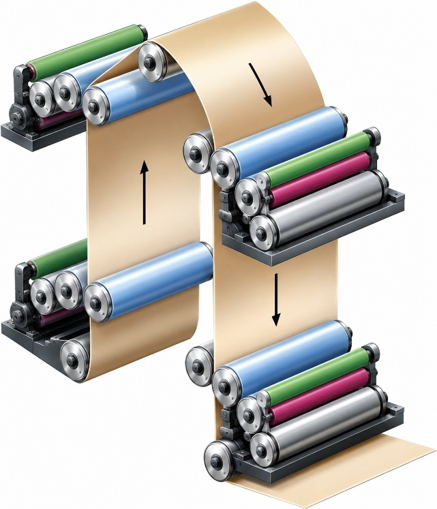
In a stack press, the printing units are positioned vertically, one above another. Each color station is arranged independently, allowing the press to print multiple colors sequentially.
Advantages
- Ability to print on a wide range of substrates.
- Suitable for both long and short production runs.
- Excellent accessibility for maintenance.
Applications
- Paper bags
- Corrugated cartons
- Flexible packaging materials
2. In-Line Press
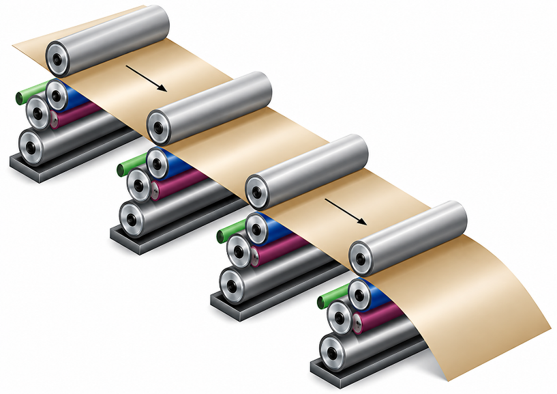
An in-line press consists of printing stations arranged horizontally in a straight line. Additional converting processes, such as die-cutting, laminating, embossing, and varnishing, can easily be integrated into the production line.
- Advantages
- High productivity.
- Easy integration of finishing operations.
- Reduced production time.
- Applications
- Labels and tags
- Shrink sleeves
- Folding cartons
3. Common Impression (CI) Press
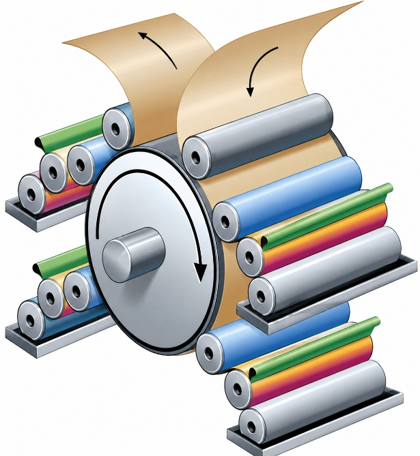
In a common impression press, all printing stations surround a single large impression cylinder. This design provides outstanding registration accuracy and excellent print consistency.
Advantages
- Superior print registration.
- Exceptional image quality.
- Ideal for lightweight and flexible substrates.
Applications
- Food packaging
- Plastic films
- Aluminum foil laminates
- Flexible packaging products
The development of advanced ceramic anilox technology, laser engraving, digital plate imaging, and automated ink-management systems has significantly improved the efficiency, consistency, and print quality of modern flexographic printing operations.