
Flexographic Photopolymer Printing Plates
History, Product development & Present Status
Flexographic photopolymer printing plates have evolved from relatively simple rubber relief plates into highly engineered digital photopolymer systems capable of reproducing extremely fine dots, micro-text, high-definition graphics, and extended-gamut color work. Their development has closely followed advances in photopolymer chemistry, digital imaging, laser technology, screening, plate surface technology, and flexographic press control.
Historical Development
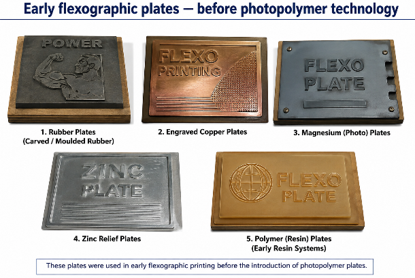
Early flexographic plates — before photopolymer technology
Flexography originally relied heavily on rubber printing plates. Rubber plates were produced through molding or vulcanization and were widely used for packaging, labels, paper bags, newspapers, and corrugated applications.
Although rubber was flexible and durable, it had important limitations:
- Difficulty reproducing very fine details
- Inconsistent plate thickness
- Limited tonal range
- Dot gain and deformation
- Less predictable plate-to-plate consistency
- Labor-intensive plate production
The search for a more precise and reproducible plate material eventually led to photopolymer technology.
- Introduction of Photopolymer Plates
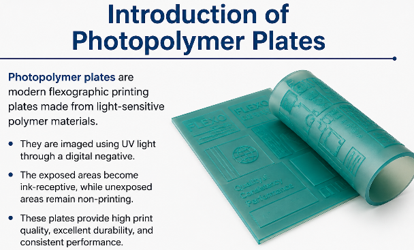
The development of light-sensitive polymer materials was a major breakthrough for flexography.
Photopolymer plates use a polymer that changes its physical properties when exposed to ultraviolet radiation. In simplified terms:
UV exposure → polymerization/cross-linking → hardened image areas → washout or processing → relief printing plate
This technology provided substantially better control of:
- Relief depth
- Fine dots
- Text and line work
- Plate thickness
- Repeatability
- Production time
By the 1970s and 1980s, photopolymer plates became increasingly important in commercial flexographic printing.
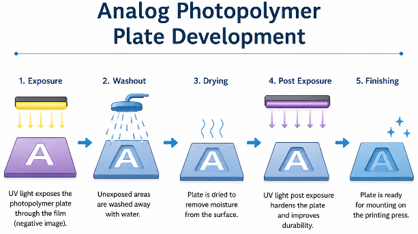
Early photopolymer plates were generally produced through an analog photographic process. A photographic negative was placed over the plate material and exposed to UV light. The exposed portions polymerized, while the unexposed material was removed during processing.
- Analog Photopolymer Plate Development
The traditional plate-making sequence was broadly:
Negative film → Back exposure → Main exposure → Washout → Drying → Finishing → Final exposure
The process required considerable operator skill.
Important variables included:
- UV exposure energy
- Film density
- Vacuum/contact quality
- Plate thickness
- Washout temperature
- Washout time
- Brush pressure
- Drying conditions
- Final exposure
Film quality also imposed limitations on the reproduction of very small dots and fine screening
- Digital Revolution — Computer-to-Plate
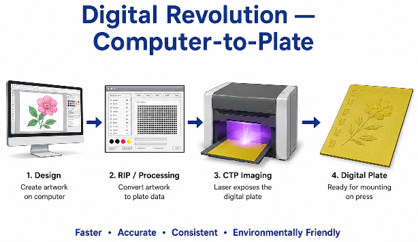
One of the biggest changes in flexographic prepress was the transition from analog film-based plates to digital photopolymer plates.
The introduction of Computer-to-Plate (CTP) technology eliminated the conventional photographic negative. A digital flexographic plate generally contains a black laser-ablatable mask layer.
The basic process became:
Digital artwork → RIP → Laser imaging → Black mask ablation → UV exposure → Washout → Drying → Finishing → Final exposure
A laser selectively removes the black mask according to the digital image. UV light then polymerizes the plate through the remaining mask.
This development significantly improved:
- Dot reproduction
- Repeatability
- Registration
- Fine typography
- Highlight dots
- Process control
- Automation
- Production consistency
It also opened the door to sophisticated screening technologies and surface structures.
- Development of Flat-Top Dots
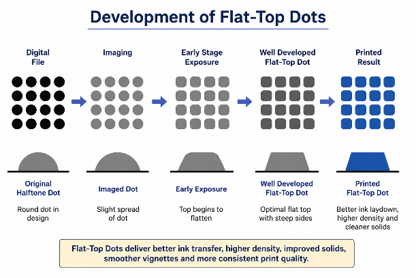
One of the major milestones in modern flexographic plates was the development of flat-top dot technology.
Traditional photopolymer dots often had a rounded or curved shoulder. Modern flat-top-dot technology produces a dot with a flatter printing surface.
Conceptually:
Traditional dot
/\
Flat-top dot
┌─┐
Flat-top dots can provide:
- More stable highlights
- Better ink transfer
- Higher solid ink density
- Reduced dot gain
- Improved print contrast
- Better consistency during long runs
Flat-top dots can be generated through different technological approaches, including controlled exposure, oxygen management, surface treatments, and specialized plate technologies.
- High-Definition Flexographic Plates
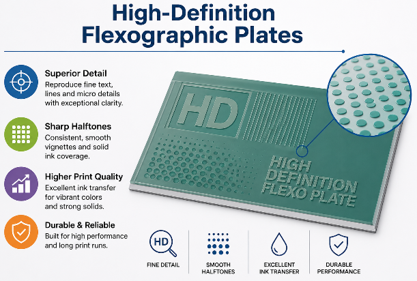
The next major stage was the development of HD Flexo and other high-definition plate technologies.
These systems combined:
- High-resolution imaging
- Advanced screening
- Fine plate structures
- Flat-top dots
- Surface micro-texturing
- Improved exposure control
The objective was not simply to make a smaller dot. The objective was to control the entire plate/ink/substrate/press system.
Modern plate technologies can incorporate engineered surface textures that influence ink transfer.
This can help achieve:
- Higher ink density
- Improved tonal smoothness
- Better highlight reproduction
- Reduced ink consumption
- More consistent solids
- Improved print quality
- Digital Plate Surface Screening
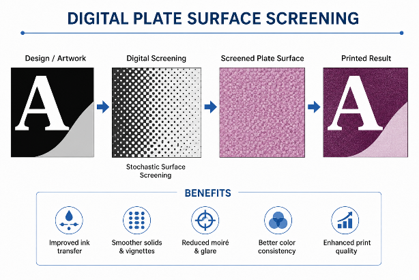
Modern digital flexographic plates can incorporate surface screening or micro-texture.
Instead of having a completely smooth plate surface, microscopic structures are engineered into the plate.
These structures can influence:
Ink pickup → Ink transfer → Ink film thickness → Density → Print appearance
This technology is particularly important for:
- Process colors
- Expanded gamut printing
- High-density solids
- White ink
- Flexible packaging
- Labels
- Corrugated preprint
The plate surface can therefore become an active part of the ink-transfer system rather than simply being a carrier of the image.
- Evolution of Photopolymer Plate Chemistry
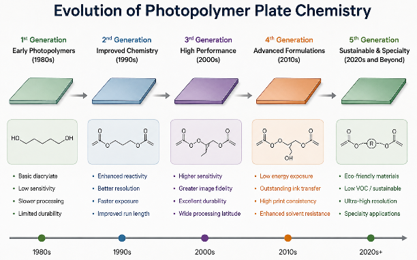
Photopolymer chemistry has also advanced considerably.
Modern plate formulations are engineered to provide controlled combinations of:
- Sensitivity
- Hardness
- Resilience
- Solvent resistance
- UV resistance
- Thermal stability
- Ink compatibility
- Plate durability
- Clean processing
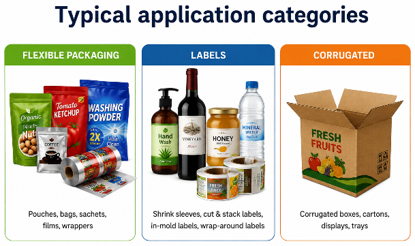
Typical application categories
Flexible Packaging
- Solvent-based inks
- Water-based inks
- UV/LED-UV inks
- Film substrates
- Paper and foil
Labels
- UV inks
- Water-based inks
- Narrow-web applications
- Combination printing
Corrugated
- Water-based inks
- Direct print
- Preprint
- High-volume production
- Plate Thickness Development
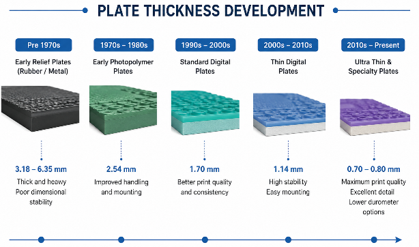
Flexographic plates are available in many thicknesses depending on the application.
Common thickness categories include approximately:
- 0.73 mm
- 0.95 mm
- 1.14 mm
- 1.70 mm
- 2.54 mm
- 2.84 mm
- 3.94 mm
Other customized thicknesses
The correct thickness depends on:
- Press specification
- Plate cylinder/sleeve
- Plate mounting system
- Substrate
- Printing process
- Impression settings
- Plate relief requirement
For example, 1.14 mm plates are widely associated with certain narrow-web and label applications, while thicker plates are commonly used in corrugated and other applications.
- Digital Plate Imaging Technology
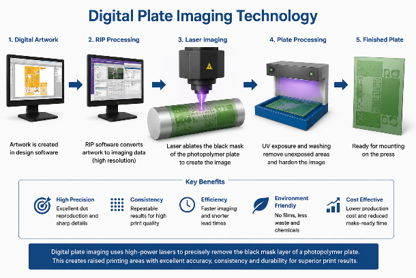
Modern digital photopolymer plates typically use a laser-ablatable carbon mask.
A typical workflow is:
1. Prepress file
↓
2. RIP and screening
↓
3. Laser ablation of black mask
↓
4. Back exposure
↓
5. Main exposure
↓
6. Washout
↓
7. Drying
↓
8. Finishing / detackification
↓
9. Final exposure
↓
10. Plate inspection and QC
The quality of the digital plate depends on the control of every stage.
- Exposure Technology
Exposure is one of the most critical parameters in photopolymer plate production.
Back exposure
Back exposure establishes the floor and relief depth of the plate.
Main exposure
Main exposure polymerizes the image-forming areas.
Finishing / detackification
The plate surface may require a finishing treatment to eliminate surface tackiness.
Final exposure
Final UV exposure completes polymerization and stabilizes the plate.
The wavelengths and exposure energies must be matched to the specific photopolymer plate system.
For example, UVA exposure is commonly used for photopolymerization, while shorter-wavelength UV exposure may be used in specific finishing/detackification processes.
12. Plate Processing Technology
Traditional solvent-wash plates require processing systems that remove unpolymerized material.
Modern plate technologies increasingly include:
Solvent processing
Uses organic solvent systems.
Water-wash processing
Uses aqueous processing and can reduce the environmental burden associated with solvent handling.
Thermal processing
Uses heat and absorbent materials to remove unpolymerized photopolymer.
Digital / direct processing developments
Automation and optimized plate systems continue to reduce processing variability and production time.
13. Environmental Development
Environmental requirements have become a major driver of plate development.
- The industry is increasingly focused on:
- Reduced solvent consumption
- Reduced VOC emissions
- Water-wash technology
- Thermal processing
- Faster plate production
- Lower energy consumption
- Reduced waste
- Longer plate life
- Reduced ink consumption
Sustainability is no longer considered only an environmental issue; it is also connected with productivity, operating cost and regulatory compliance.
- Current Status — 2026
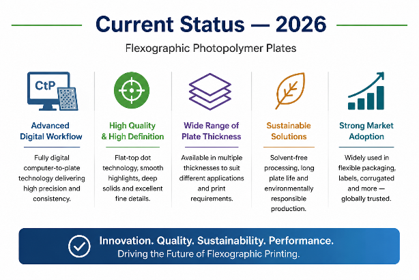
Today, flexographic photopolymer plates are a highly sophisticated prepress technology, particularly in flexible packaging, labels, corrugated and paper packaging.
The modern plate is no longer simply a relief image.
It is effectively an engineered ink-transfer surface.
Current technology focuses on controlling:
Plate chemistry + digital imaging + screening + dot geometry + surface texture + exposure + processing + mounting + press characterization
to achieve predictable print performance.
Current major trends
1. High-definition imaging
Higher-resolution imaging and advanced screening allow very fine details and tonal reproduction.
2. Flat-top dots
Widely used to improve stability and ink transfer.
3. Surface screening
Micro-textured surfaces are engineered to optimize ink transfer.
4. Expanded Gamut printing
Modern plates support CMYK + Orange + Green + Violet and other fixed-palette workflows.
5. Process control
Plate production is increasingly connected with standardized fingerprinting and color-management systems.
6. Automation
Plate imaging, exposure, processing and inspection are increasingly automated.
7. Sustainable plates
Water-wash, thermal and lower-solvent technologies continue to develop.
8. LED UV technology
UV-LED exposure systems are becoming increasingly important because of their energy efficiency, stability and reduced heat generation.
9. Advanced plate inspection
Digital inspection systems can identify:
- Missing dots
- Pinholes
- Surface defects
- Dimension variations
- Image abnormalities
- Contamination
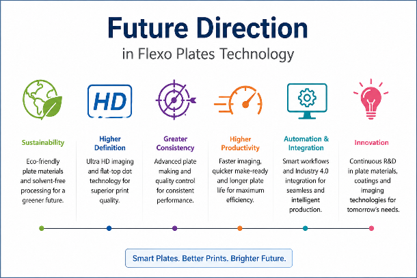
Future Direction
The future of photopolymer flexographic plates is moving toward greater precision, automation and sustainability.
The next generation is likely to emphasize:
- AI-assisted plate optimization
- Automated plate inspection
- More precise micro-surface structures
- Higher-resolution imaging
- Better highlight-dot stability
- Reduced plate production time
- Lower energy consumption
- Lower solvent usage
- Greater plate durability
- Closed-loop prepress-to-press control
- Improved compatibility with water-based and LED-UV inks
- Digital integration with press fingerprinting and color management
The ultimate objective is:
Predictable ink transfer and predictable color from the prepress department to the printing press.
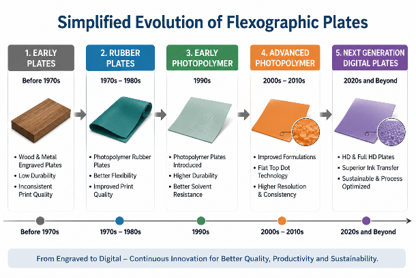
Simplified Evolution of Flexographic Plates
Rubber plates
↓
Conventional photopolymer plates
↓
Analog film photopolymer plates
↓
Digital photopolymer / CTP plates
↓
Flat-top-dot technology
↓
HD Flexo plates
↓
Surface-screened / micro-textured plates
↓
High-definition + expanded-gamut plates
↓
Sustainable water-wash / thermal technologies
↓
Automated, data-driven, high-definition plate systems
Bottom Line
The history of flexographic photopolymer plates is essentially a progression from mechanical relief reproduction to digitally engineered ink-transfer technology. The greatest advances have come from the combination of photopolymer chemistry, digital laser imaging, flat-top dots, advanced screening, surface texturing, precise exposure and process control.
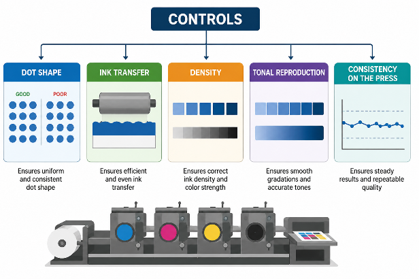
Controls
Today, the quality of a flexographic plate is determined not only by its resolution, but by how accurately it controls dot shape, ink transfer, density, tonal reproduction and consistency on the press.
Author’s Note
Flexographic photopolymer printing plates are at the heart of modern flexographic printing, directly influencing print quality, consistency, productivity, and overall press performance. Advances in digital imaging, photopolymer chemistry, surface screening, flat-top dot technology, and controlled exposure systems have transformed plate making from a traditional craft into a highly precise prepress process.
This presentation is intended to provide a practical understanding of flexographic photopolymer printing plates—from their basic construction and manufacturing principles to digital imaging, exposure, processing, plate characterization, quality control, and current technological developments.
The objective is not only to explain how a flexographic plate is produced, but also to demonstrate how plate technology affects ink transfer, dot reproduction, tonal range, registration, color consistency, and press efficiency.
As flexographic printing continues to evolve toward higher line screens, finer highlights, expanded gamut printing, UV/LED inks, sustainable substrates, and faster production speeds, the importance of accurate plate selection, imaging, exposure, and quality control will continue to increase.
The right plate, correctly imaged and properly processed, is the foundation of consistent flexographic printing performance.